
Muse cells
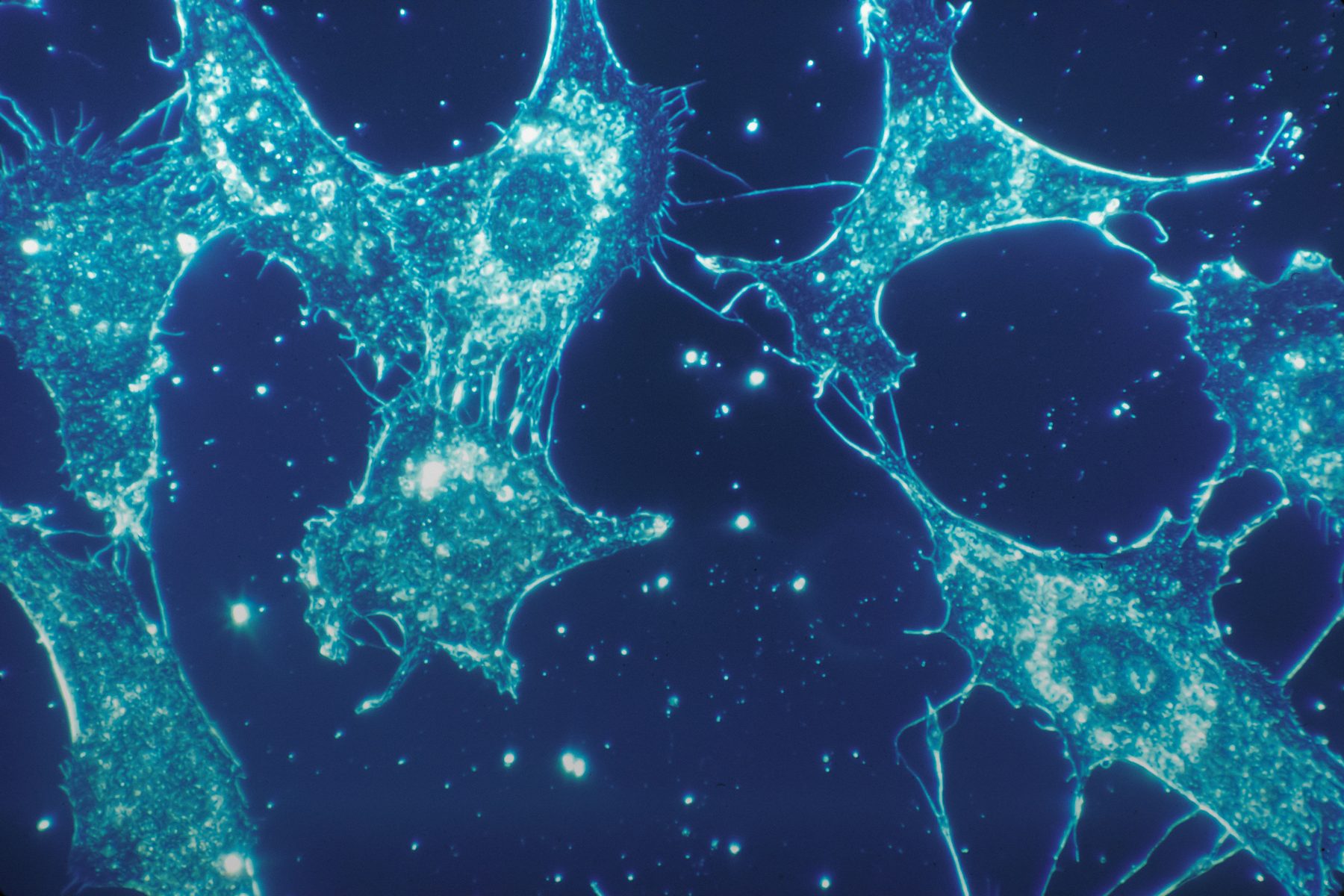
Muse cells are a small subgroup of cells found among mesenchymal stromal cells and fibroblasts. Researchers are studying whether they can find damaged tissue in the body. They are not approved anywhere, and they are not part of our programme. We follow the trial results as they are published.
What Muse cells are.
Muse cells were first described in 2010 by a research group in Japan. They carry a surface marker called SSEA-3, which lets researchers identify them and separate them from other cells.
They are found within two groups of cells: mesenchymal stromal cells, often called mesenchymal stem cells, and fibroblasts, the cells of connective tissue.
What researchers are studying.
The main question is whether Muse cells can find damaged tissue in the body and settle there. Researchers call this homing. It is not yet known whether this leads to a lasting benefit for patients.
What clinical trials have found.
In stroke, a randomised, placebo-controlled trial of a Muse cell product called CL2020 was published in 2023. It included 35 patients with subacute ischaemic stroke. Each received a single injection into a vein: 25 were given CL2020 and 10 a placebo. The primary endpoint was safety at 12 weeks. At that point, 10 of 25 patients in the Muse cell group and 1 of 10 in the placebo group had a score of 2 or lower on the modified Rankin Scale. This score means a person can look after themselves without help from others. The two groups were not formally compared.
In ALS, an open-label phase 2 study of a Muse cell product was published in 2023. It took place at a single centre. Five patients received the product into a vein once a month, six doses in all. Open-label means everyone knew it was being given. The authors reported no serious side effects. The change on the ALSFRS-R, a rating scale of everyday function in ALS, was not statistically significant, and the authors propose a large double-blind trial.
Muse cells are not approved for any condition, in any country.
Muse cells and our programme.
Caplan Institute does not offer Muse cells. Mesenchymal stromal cells are already part of our Advanced Neuroregeneration programme. The programme brings together cell therapy with regulatory T cells and mesenchymal stromal cells, concentrated exosomes, peptide protocols, personalised non-invasive neurostimulation and neurorehabilitation, given as one course.
The board reviews your documents first and then decides which components to use and how to combine them. For the conditions we treat, these methods are investigational.
Studies cited on this page
- Unique multipotent cells in adult human mesenchymal cell populationsKuroda et al. Proc Natl Acad Sci U S A, 2010. PMID 20421459.
- Randomized placebo-controlled trial of CL2020, an allogenic Muse cell-based product, in subacute ischemic strokeNiizuma et al. J Cereb Blood Flow Metab, 2023. PMID 37756573.
- Safety and Clinical Effects of a Muse Cell-Based Product in Patients With Amyotrophic Lateral Sclerosis: Results of a Phase 2 Clinical TrialYamashita et al. Cell Transplant, 2023. PMID 38014622.
Ask about cell therapy for your diagnosis.
Send us the diagnosis and your recent records. The medical board will tell you whether our programme is suitable, and a patient coordinator will stay in touch with you throughout.
By submitting this form, you consent to Caplan processing your personal data for the purpose of medical consultation in accordance with applicable data protection regulations.